Those Maya Lin Conbine Her Chinnesse and American Side in Art
| Maya Lin | |
|---|---|
 Maya Lin, in 2014 | |
| Born | Maya Ying Lin (1959-10-05) October 5, 1959 Athens, Ohio, U.S. |
| Nationality | American |
| Education | Yale University |
| Known for | State fine art, architecture, memorials |
| Notable work | Vietnam Veterans Memorial (1982) Civil Rights Memorial (1989) |
| Spouse(s) | Daniel Wolf |
| Children | 2 |
| Awards | National Medal of Arts Presidential Medal of Freedom |
| Website | mayalin |
| Maya Lin | |||||||
|---|---|---|---|---|---|---|---|
| Traditional Chinese | 林瓔 | ||||||
| Simplified Chinese | 林璎 | ||||||
| |||||||
Maya Ying Lin (built-in Oct v, 1959) is an American designer and sculptor. In 1981, while an undergraduate at Yale University, she achieved national recognition when she won a national pattern competition for the planned Vietnam Veterans Memorial in Washington, D.C.[1]
Lin has designed numerous memorials, public and private buildings, landscapes, and sculptures. Although, she is best known for historical memorials, she is too known for environmentally themed works, which frequently address ecology decline. According to Lin, she draws inspiration from the compages of nature but believes that nothing she creates can match its beauty.
Childhood [edit]
Maya Lin was born in Athens, Ohio. Her parents emigrated from China to the United States, her father in 1948 and her mother in 1949, and settled in Ohio earlier Lin was built-in.[2] Her father, Henry Huan Lin, born in Fuzhou, Fujian, was a ceramist and dean of the Ohio University College of Fine Arts. Her female parent, Julia Chang Lin, born in Shanghai, is a poet and a quondam professor of literature at Ohio University. She is the "half" niece of Lin Huiyin, who was an American-educated artist and poet, and said to accept been the first female architect in modern Mainland china.[3] Lin Juemin and Lin Yin Ming, both of whom were among the 72 martyrs of the Second Guangzhou insurgence, were cousins of her grandpa.[4] Lin Chang-min, a Hanlin of Qing dynasty and the emperor's teacher, Lin Huiyin was his daughter with his wife, while Maya Lin'south father Henry HUan Lin was his illegitimate son with his concubine.[5]
According to Lin, she "didn't even realize" she was ethnically Chinese until later in life, and that only in her 30s did she learn an interest in her cultural background.[half-dozen]
Lin has said that she did not have many friends when growing up, stayed home a lot, loved to written report, and loved school. While still in high schoolhouse she took courses at Ohio University where she learned to cast statuary in the school'south foundry.[7] She graduated in 1977 from Athens High School in The Plains, Ohio, after which she attended Yale Academy where she earned a Bachelor of Arts in 1981 and a Master of Compages in 1986.[8]
Environmental concerns [edit]
According to Lin, she has been concerned with ecology issues since she was very young, and dedicated much of her time at Yale Academy to environmental activism.[9] She attributes her interest in the surroundings to her upbringing in rural Ohio: the nearby Hopewell and Adena Indian burial mounds inspired her from an early historic period.[10] Noting that much of her later work has focused on the human relationship people have with their surround, equally expressed in her excavation, sculptures, and installations, Lin said, "I'1000 very much a product of the growing sensation about ecology and the ecology movement...I am very drawn to landscape, and my piece of work is about finding a remainder in the landscape, respecting nature non trying to dominate information technology. Even the Vietnam Veterans Memorial is an earthwork. All of my work is about slipping things in, inserting an gild or a structuring, yet making an interface then that in the end, rather than a hierarchy, at that place is a balance and tension between the homo-made and the natural."
According to the scholar Susette Min, Lin'south piece of work uncovers "subconscious histories" to bring attention to landscapes and environments that would otherwise exist inaccessible to viewers and "deploys the concept to discuss the inextricable relationship between nature and the built environment".[11] Lin'due south focus on this human relationship highlights the impact humanity has on the environment, and draws attention to problems such every bit global warming, endangered bodies of water, and animal extinction/endangerment. She has explored these bug in her recent memorial, chosen What Is Missing?
According to 1 commentator, Lin constructs her works to have a minimal environmental consequence by utilizing recycled and sustainable materials, by minimizing carbon emissions, and past attempting to avoid damaging the landscapes/ecosystems where she works.[12]
In addition to her other activities equally an environmentalist, Lin has served on the Natural Resource Defense Council lath of trustees.
Vietnam Veterans Memorial [edit]
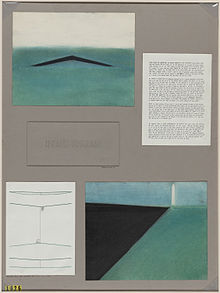
Maya Lin's winning submission for the Vietnam Veterans Memorial design competition
In 1981, at 21 and still an undergraduate student, Lin won a public blueprint contest to pattern the Vietnam Veterans Memorial, to be built on the National Mall in Washington D.C. Her design, 1 of i,422 submissions,[13] specified a black granite wall with the names of 57,939 fallen soldiers carved into its face (hundreds more accept been added since the dedication),[fourteen] [15] to be v-shaped, with one side pointing toward the Lincoln Memorial and the other toward the Washington Monument.[14] The memorial was completed in late October 1982 and dedicated in November 1982.[16]
According to Lin, her intention was to create an opening or a wound in the earth to symbolize the pain caused past the war and its many casualties. "I imagined taking a pocketknife and cutting into the globe, opening it upwardly, and with the passage of time, that initial violence and hurting would heal," she recalled.[17]
Her winning design was initially controversial for several reasons: its minimalist design,[18] her lack of professional experience, and her Asian ethnicity.[6] [19] [twenty] According to i writer, "Some viewed her selection every bit an affront. They could not empathize how a woman, a youth, and a Chinese American could design a memorial for men, for soldiers, and for Americans."[21] Some objected to the exclusion of the surviving veterans' names, while others complained about the dark complexion of the granite, claiming that it expressed a negative attitude towards the Vietnam War. Lin dedicated her design before the U.s. Congress, and a compromise was reached: The Three Soldiers, a bronze depiction of a group of soldiers and an American flag were placed to the side of Lin's pattern.[10]
Notwithstanding the initial controversy, the memorial has become an of import pilgrimage site for relatives and friends of the expressionless soldiers, many of whom leave personal tokens and mementos in retentiveness of their loved ones.[22] [23] In 2007, an American Institute of Architects poll ranked the memorial No. x on a list of America's Favorite Architecture, and information technology is now ane of the most visited sites on the National Mall.[10] Furthermore, information technology now serves as a memorial for the veterans of the Afghanistan and Iraq wars.[10] There is a collection with items left since 2001 from the Vietnam Veterans Memorial Fund, which includes handwritten letters and notes of those who lost loved ones during these wars. There is as well a pair of gainsay boots and a note with information technology defended to the veterans of the Vietnam War, that reads "If your generation of Marines had non come home to jeers, insults, and protests, my generation would not come habitation to thanks, handshakes and hugs."[10]
Lin once said that if the contest had non been held "blind" (with designs submitted by name instead of number), she "never would have won" on business relationship of her ethnicity. Her assertion is supported past the fact that she was harassed afterward her ethnicity was revealed, as when prominent businessman and later third-party presidential candidate Ross Perot called her an "egg roll."[24]
Later work [edit]

Sculpture made of multiple wood 2x4 pieces, on brandish at the De Young Museum in San Francisco (2009)

Lin, who at present owns and operates Maya Lin Studio in New York City, has designed numerous projects following the Vietnam Veterans Memorial, including the Civil Rights Memorial in Montgomery, Alabama (1989) and the Moving ridge Field outdoor installation at the University of Michigan (1995).[25] Lin is represented past the Pace Gallery in New York City.[26]
A partial listing of works [edit]
- Moving ridge Field (completed in 1995). Lin created Wave Field, for the Academy of Michigan. She was inspired past both diagrams of fluids in motion and photographs of body of water waves. She was intrigued by the idea of capturing and freezing the motion of water, and she wished to capture that movement in the earth, rather than through photography. That was her starting time experience with earthworks.[27]
- Confluence Project (completed in 2000), a series of outdoor installations at historical points along the Columbia River and Snake River in united states of america of Washington and Oregon.[28]
- Eleven Minute Line (completed in 2004), an earthwork in Sweden that was designed for the Wanås Foundation. Lin drew inspiration from the Serpent Mounds (Native American burial mounds) located in her habitation land, Ohio. It is meant to be a walkway for the viewers to experience, taking xi minutes to complete.[27] The earthwork is likewise inspired by Robert Smithson's Spiral Jetty.
- A new plaza (completed in 2005), intended to anchor the Claire Trevor Schoolhouse of the Arts at the University of California, Irvine.[29] [30]
- Waterline (completed in 2006), composed of aluminum tubing and pigment. Lin has described the piece as a drawing instead of a sculpture. It is a to-scale representation of the Mid-Atlantic ridge, and it is installed and so that viewers may walk on the underwater mountain range. There is a purposeful ambivalence to where the actual water line is in relation to the mountain range, to highlight viewers' relationship to the surroundings and their outcome on bodies of water.[31] [32]
- Bodies of Water serial (completed in 2006), consisting of representations of 3 bodies of water, "The Blackness Sea," "The Caspian Sea," and "The Red Bounding main". Each sculpture is fabricated of layers of birch plywood, and are to-scale representations of three endangered bodies of h2o. The sculptures are balanced on the deepest point of the sea. Lin wished to call attending to the "unseen ecosystems" that people continue to pollute.[33]
- Input (with Tan Lin, completed in 2004). Lin was commissioned by Ohio University to design what is known as Input in that establishment'south Bicentennial Park,[34] a landscape designed to resemble a reckoner dial card. The work relates to Lin's first official connection with the academy. The daughter of the late Professor Emerita of English Julia Lin and the belatedly Henry Lin, dean emeritus of the Higher of Fine Arts, Maya Lin studied computer programming at the university while in high schoolhouse. The installation is located in a iii.5-acre park. It has 21 rectangles, some raised and some depressed, resembling computer punch cards, a mainstay of early on programming courses.[35]
- In a higher place and Below (completed in 2007), an outdoor sculpture at the Indianapolis Museum of Fine art in Indiana. The artwork is made of aluminum tubing that has been electrolytically colored by anodization.
- ii × 4 Landscape (completed in 2008), a 30-ton sculpture made of many pieces of wood, which was exhibited at the M.H. de Young Memorial Museum, in San Francisco.[36] The sculpture itself is evocative of the swelling movement of h2o, which is juxtaposed with the dry materiality of the lumber pieces. According to Lin, 2 × iv Landscape was her effort to bring the feel of Wavefield (1995) indoors. The 2 × 4 pieces are also meant to exist reminiscent of pixels, to evoke the "virtual or digital infinite that nosotros are increasingly occupying."[37]
- Moving ridge Field, (completed in 2008), at the Storm King Art Center in New York state.[38] [39] It is the center'south starting time earthwork, spanning 4 acres of country, and is a larger version of her original Wave Field (1995) that focuses on the "fusion of opposites,"[40] comparing the motion of water to the textile of the globe.
- Design of a edifice (2009) for the Museum of Chinese in America, nearly New York City's Chinatown, Lin attached a personal significance to the project being a Chinese-related project, explaining that she wants her two daughters to "know that part of their heritage".[ii]
- Silver River (2009), her start work of fine art in the Las Vegas Strip. Information technology is role of a public fine art collection at MGM Mirage's CityCenter, which opened December 2009. Lin created an 84-pes (26 m) cast of the Colorado River made entirely of reclaimed silver. With the sculpture, Lin wanted to make a statement nigh water conservation and the importance of the Colorado River to Nevada in terms of free energy and water.[41] [42] [43] The sculpture is displayed behind the front end desk of the Aria Resort and Casino.
- A Fold in the Field (completed in 2013). Her largest work to date, it was built from 105,000m cubic meters of earth, covering 3 hectares. Information technology forms role of a individual collection inside a sculpture park, endemic by Alan Gibbs, north of Auckland, New Zealand.[44]
- Since around 2010, Lin has been working on what she calls "her final memorial,"[45] the What Is Missing? Foundation, to commemorate the biodiversity that has been lost in the planet's sixth mass extinction. She aims to enhance awareness about the loss of biodiversity and natural habitats past using sound, media, science, and art for temporary installations and a web-based project. What Is Missing? exists not in one specific site simply in many forms and in many places simultaneously.[46]
- From 2015 to 2021, Lin worked on the renovation and reconfiguration of the Neilson Library and its grounds at Smith Higher.[47] A project in Madison Square Park, "Ghost Forest," was postponed until 2021.[48]
- Both What is Missing and the Vietnam Veterans Memorial were referred to by the White House in its press release that announced Lin as ane of the 2016 recipients of the Presidential Medal of Freedom. Nature and the environment have been central concerns for Lin in both her art and architecture: "Every bit an artist I often work in serial, and so for me, I wanted my last memorial to exist on a subject that I take personally been concerned with and connected to since I was a child. The last memorial is "What Is Missing?" And encompasses multiple platforms, with temporary and permanent physical installations likewise as an interactive online component."[49] She has expressed her concerns for the goals of the Trump administration: "I retrieve nature is resilient— if we protect it—and with my groundwork I wanted to lend a phonation to the incredible threat we are under from climate change and species and habitat loss."[49]
Exhibitions [edit]
- Il Cortile Mare (1998-1999), an exhibition of furniture design, maquettes and photos of works at the American Academy in Rome.[50]
Written works [edit]
- Maya Lin, Boundaries (New York: Simon & Schuster, 2000).[51] [52]
Design methodology [edit]
Maya Lin calls herself a "designer," rather than an "architect".[53] Her vision and her focus are e'er on how space needs to be in the time to come, the balance and relationship with the nature and what it means to people. She has tried to focus less on how politics influences pattern and more than on what emotions the infinite would create and what it would symbolize to the user. Her conventionalities in a space being connected and the transition from within to exterior being fluid, coupled with what a infinite means, has led her to create some very memorable designs. She has also worked on sculptures and landscape installations, such equally "Input" artwork at Ohio University. In doing so, Lin focuses on memorializing concepts of time periods instead of direct representations of figures, creating an abstract sculptures and installations.[ citation needed ]
Lin believes that fine art should be an act of any individual who is willing to say something that is new and not quite familiar.[54] In her own words, Lin's work "originates from a unproblematic desire to make people aware of their surroundings, not only the physical globe merely also the psychological world nosotros live in."[55] Lin describes her creative process as having a very important writing and verbal component. She first imagines an artwork verbally to sympathize its concepts and meanings. She believes that gathering ideas and data is especially vital in architecture, which focuses on humanity and life and requires a well-rounded mind.[56] When a project comes her way, she tries to "understand the definition (of the site) in a verbal before finding the class to empathize what a piece is conceptually and what its nature should be even earlier visiting the site".[54] Later on she completely understands the definition of the site, Lin finalizes her designs by creating numerous renditions of her project in model form.[55] In her historical memorials, such as the Vietnam Veterans Memorial, the Women'due south Table, and the Civil Rights Memorial, Lin tries to focus on the chronological attribute of what she is memorializing. That theme is shown in her art memorializing the changing environs and in charting the depletion of bodies of h2o.[57] Lin also explores themes of juxtaposing materials and a fusion of opposites: "I feel I exist on the boundaries. Somewhere between science and art, art and architecture, public and individual, e and west.... I am e'er trying to find a balance between these opposing forces, finding the place where opposites run across... existing not on either side only on the line that divides."[58]
Personal life [edit]
Lin was married to Daniel Wolf (1955–2021), a photography dealer and collector.[59] She has homes in New York and rural Colorado, and is the mother of ii daughters, Bharat and Rachel.[47] She has an older brother, the poet Tan Lin.
Recognition [edit]
Lin has been awarded honorary doctorate degrees from Yale University, Harvard University, Williams College, and Smith College.[8] In 1987, she was among the youngest to be awarded an honorary Doctorate of Fine Arts past Yale University.[54]
In 1994, she was the subject of the University Award-winning documentary Maya Lin: A Strong Clear Vision. Its championship comes from an accost she gave at Juniata College in which she spoke of the monument pattern procedure in the origin of her piece of work; "My piece of work originates from a simple want to make people aware of their surroundings and this tin include not only the concrete but the psychological world that we live in."[54]
In 2002, Lin was elected Alumni Fellow of the Yale Corporation, the governing body of Yale University (upon whose campus sits some other of Lin's designs, the Women'due south Tabular array, designed to commemorate the role of women at Yale Academy), in an unusually public contest. Her opponent was W. David Lee, a local New Haven minister and graduate of the Yale Divinity School, who was running on a platform to build ties to the community with the back up of Yale's unionized employees. Lin was supported by Yale President Richard Levin and other members of the Yale Corporation, and she was the officially endorsed candidate of the Association of Yale Alumni.
In 2003, Lin was chosen to serve on the pick jury of the World Merchandise Center Site Memorial Contest. A trend toward minimalism and abstraction was noted among the entrants and the finalists besides as in the chosen pattern for the Earth Trade Center Memorial.
In 2005, Lin was elected to the American Academy of Arts and Letters, every bit well as the National Women's Hall of Fame in Seneca Falls, New York.
In 2009, Lin was awarded the National Medal of Arts by President Barack Obama.[60]
In 2016, Lin was awarded the Presidential Medal of Liberty past President Barack Obama.[61]
Awards and honors [edit]
- 1999: Rome Prize
- 2000: Golden Plate Award of the American University of Achievement[62]
- 2003: Finn Juhl Prize
- 2005: elected to The American Academy of Arts and Letters
- 2005: elected to National Women's Hall of Fame in Seneca Falls, New York
- 2007: AIA Twenty-five Twelvemonth Award
- 2009: National Medal of Arts[63]
- 2014: The Dorothy and Lillian Gish Prize, a $300,000 art prize[64]
- 2016: Presidential Medal of Liberty[61]
Selected works [edit]
- Vietnam Veterans Memorial (VVM) (1980–82), Washington, D.C.[65]
- Adjustment Reeds (1985), New Haven, Connecticut[65]
- Civil Rights Memorial (1988–89), Montgomery, Alabama[65]
- Open-Air Peace Chapel (1988–89), Juniata Higher, Huntingdon, Pennsylvania[65]
- Topo (1989–91), Charlotte Sports Coliseum, Charlotte, North Carolina[65]
- Eclipsed Time (1989–95), Pennsylvania Station, New York Metropolis[65]
- Women's Table (1990–93), Yale Academy, New Haven, Connecticut[65]
- Weber Firm (1991–93), Williamstown, Massachusetts[65]
- Groundswell (1992–93), Wexner Middle for the Arts, Columbus, Ohio[65]
- Museum for African Art (1992–93), New York City[65]
- Wave Field (1993–95), FXB Aerospace Engineering Edifice, Academy of Michigan, Ann Arbor, Michigan[65]
- x Degrees North (1993–96), Rockefeller Foundation Headquarters, New York City[65]
- A Shift in the Stream (1995–97), Principal Fiscal Group Headquarters, Des Moines, Iowa[65]
- Reading a Garden (1996–98), Cleveland Public Library, Cleveland, Ohio[65]
- Private Duplex Apartment, New York City (1996–98), New York[65]
- Topographic Landscape (1997) (Portable sculpture)[65]
- Phases of the Moon (1998) (Portable sculpture)[65]
- Avalanche (1998) (Portable sculpture)[65]
- Langston Hughes Library (1999), Clinton, Tennessee[65]
- Timetable (2000), Stanford University, Stanford, California[65]
- The character of a colina, under glass (2000–01), American Express Client Services Centre, Minneapolis, Minnesota[65]
- Ecliptic (2001), Grand Rapids, Michigan[65]
- Input (2004), Bicentennial Park, Athens, Ohio
- Riggio-Lynch Chapel (2004), Clinton, Tennessee
- Arts Plaza, Claire Trevor School of the Arts (2005), Irvine, California
- Confluence Project: Cape Thwarting State Park (2006)
- To a higher place and Below, Indianapolis Museum of Art (2007)
- Confluence Projection: Vancouver Country Bridge (2008)
- Confluence Project: Sandy River Delta (2008)
- Confluence Project: Sacajawea State Park (2010)
- Ellen S. Clark Hope Plaza, Washington University in St. Louis (2010)
- Confluence Project: Chief Timothy Park (2011)
- A Fold in the Field (2013), The Gibbs Farm, Kaipara Harbour, New Zealand
- "What is Missing? (2009–present), (Various locations, web project)
- Under the Laurentide, Chocolate-brown University (2015)[66]
- Folding the Chesapeake (part of Wonder exhibit): Renwick Gallery, Washington, DC (2015)
- Neilson Library (2021), Smith Higher, Northampton, Massachusetts (redesign)[67]
- Ghost Woods (2021), Madison Square Park, New York, New York[68]
Further reading [edit]
- Lin, Maya Ying; Fleming, Jeff; Brenson, Michael; Dowell-Dennis, Terri (1998). Maya Lin: Topologies (Creative person and the customs). ISBN1-888826-05-3.
- Maya Lin: [American Academy in Rome, 10 dicembre 1998-21 febbraio 1999] (1998) ISBN 88-435-6832-nine
- Timetable: Maya Lin (2000) ASIN B000PT331Y (2002, ISBN 0-937031-xix-four)
- Lin, Maya Ying; MacArio, Carla (2000). Boundaries. ISBN0-684-83417-0. (2006, ISBN 0-7432-9959-0)
- Landscape Architecture (ii/2007), page 110–115, past Susan Hines
- Sinnott, Susan (2003). Extraordinary Asian Americans and Pacific Islanders (Rev. ed.). New York: Children's Press. ISBN9780516226552.
References [edit]
- ^ Lewis, Michael J. (September 12, 2017). "The Right Manner to Memorialize an Unpopular War". The New York Times . Retrieved September 26, 2020.
- ^ a b Paul Berger (November 5, 2006). "Ancient Echoes in a Modern Space". The New York Times . Retrieved January two, 2009.
- ^ Peter G. Rowe & Seng Kuan (2004). Architectural Encounters with Essence and Form in Modern China. MIT Printing. ISBN978-0-262-68151-iii.
- ^ Donald Langmead (2011). Maya Lin: A Biography. ABC-CLIO. p. 5. ISBN978-0-313-37854-6.
- ^ Tom Lashnits (2007). Maya Lin. Asian Americans of Achievement Series. Infobase Publishing. p. 56. ISBN978-ane-4381-0036-4.
- ^ a b "Between Art and Architecture: The Memory Works of Maya Lin". American Association of Museums. July–August 2008. Archived from the original on September 15, 2008. Retrieved December 30, 2008.
- ^ "Maya Lin Biography and Interview". www.achievement.org. American Academy of Accomplishment.
- ^ a b "Maya Lin: Systematic Landscapes". Fine Arts Museums of San Francisco. Retrieved January 2, 2009.
{{cite spider web}}: CS1 maint: url-condition (link) [ permanent dead link ] - ^ Munro, Eleanor C. (2000). Originals: American women artists. Boulder, CO: Da Capo Press.
- ^ a b c d e Favorite, Jennifer G. (July ii, 2016). "'We Don't Want Another Vietnam': The Wall, the Mall, History, and Retentiveness in the Vietnam Veterans Memorial Educational activity Heart". Public Fine art Dialogue. 6 (2): 185–205. doi:10.1080/21502552.2016.1205862. ISSN 2150-2552.
- ^ Min, Susette (2009). "Entropic Designs: A Review of Maya Lin: Systematic Landscapes and Asian/American/Modern Art: Shifting Currents, 1900–1970 at the De Young Museum". American Quarterly. Vol. 61, no. one. pp. 193–215.
- ^ Mendelsohn, Meredith. "Maya Lin". Art+Auction. Vol. 33, no. 4 (Dec 2009). pp. 40–90. Art & Architecture Source, EBSCOhost (accessed April xiv, 2017).
- ^ "Vietnam Veterans Memorial". Library of Congress. Retrieved January 3, 2009.
- ^ a b "Facts and Figures". Vietnam Veterans Memorial Fund. Archived from the original on March 4, 2010. Retrieved January 3, 2009.
- ^ "Oftentimes Asked Questions". Vietnam Veterans Memorial Fund . Retrieved May 12, 2021.
- ^ "History". Vietnam Veterans Memorial Fund. Archived from the original on March 4, 2010. Retrieved Jan 3, 2009.
- ^ "The Woman Who Healed America". The Cranium . Retrieved November 5, 2019.
- ^ "Vietnam Veterans' Memorial Founder: Monument Almost Never Got Congenital". NPR.org.
- ^ Marla Hochman. "Maya Lin, Vietnam Memorial". greenmuseum.org. Archived from the original on June 21, 2010. Retrieved December 30, 2008.
- ^ Kristal Sands. "Maya Lin's Wall: A Tribute to Americans". Jack Magazine. Archived from the original on November 20, 2008. Retrieved December 30, 2008.
- ^ Viet Thanh Nguyen (2016). Nothing Ever Dies: Vietnam and the Memory of War. Harvard Academy Printing. p. 53. ISBN978-0-674-97984-0.
- ^ "Free Resources – Women's History – Biographies – Maya Lin". Gale. March 12, 2002. Archived from the original on February 3, 2002. Retrieved April 25, 2012.
- ^ "Maya Lin – Corking Buildings Online". Greatbuildings.com . Retrieved April 25, 2012.
- ^ Frank H. Wu (2002). Yellow: Race In America Beyond Black and White . Basic Books. p. 95. ISBN0-465-00639-6.
- ^ "Art:21. Maya Lin'southward "Wave Field" PBS". Pbs.org . Retrieved April 25, 2012.
- ^ Kino, Ballad (Apr 25, 2013). "'Maya Lin's New Memorial Is a City'". The New York Times . Retrieved September 23, 2013.
- ^ a b Deitsch, Dina (2009). "Maya Lin'south Perpetual Landscapes and Storm Male monarch Wavefield". Woman's Fine art Journal. Vol. 30, no. 1. p. half-dozen.
- ^ "A Meeting of Minds". The Seattle Times. June 12, 2005. Archived from the original on May seven, 2006. Retrieved September 7, 2006.
- ^ "Guide to the University of California, Irvine, Claire Trevor Schoolhouse of the Arts, Maya Lin Arts Plaza Project Records Every bit.123". Oac.cdlib.org . Retrieved Baronial 15, 2012.
- ^ "Facilities, theatres, galleries, venues, rentals, classrooms and labs. | Claire Trevor School of Arts". Arts.uci.edu. Archived from the original on Jan xix, 2012. Retrieved August 15, 2012.
- ^ Min, Susette (2009). "Entropic Designs: A Review of Maya Lin: Systematic Landscapes and Asian/American/Modern Art: Shifting Currents, 1900–1970 at the De Young Museum". American Quarterly. Vol. 61, no. 1. p. 198.
- ^ TenBrink, Marisa. "Maya Lin'southward Ecology Installations: Bringing the Outside In". p. 7.
- ^ TenBrink, Marisa. "Maya Lin's Environmental Installations: Bringing the Exterior In". p. 10.
- ^ "Bicentennial Park at Ohio University". www.ohio.edu.
- ^ "Ohio University dedicates Bicentennial Park". Athens, Ohio: Ohio University. May 15, 2004. Archived from the original on November 21, 2018. Retrieved February 27, 2018.
- ^ "Maya Lin looks at nature – from the inside". San Francisco Chronicle. October 24, 2008. Retrieved April 25, 2012.
- ^ TenBrink, Marisa. "Maya Lin's Environmental Installations: Bringing the Outside In". p. four.
- ^ Kino, Carol (November vii, 2008). "Once Inspired by a War, At present past the Country". The New York Times . Retrieved Nov 9, 2008.
On a gray, unusually muggy October day the creative person and architect Maya Lin was showing a visitor effectually Wave Field, her new earthwork projection at the Tempest King Art Center here. The 11-acre installation, which will open up to the public next jump, consists of vii rows of undulating hills cradled in a gently sloping valley.
- ^ Cotter, Holland (May vii, 2009). "Art Review | 'Tempest King Wavefield': Where the Ocean Meets the Catskills". The New York Times . Retrieved May 8, 2009.
- ^ Deitsch, Dina (2009). "Maya Lin'due south Perpetual Landscapes and Tempest Male monarch Wavefield". Woman'south Fine art Journal. Vol. thirty, no. 1. p. 3.
- ^ Friess, Steve (December 16, 2009). "Artist Maya Lin Provides 'Silverish River' for Vegas' CityCenter Megaresort". Sphere News . Retrieved January ane, 2010. [ permanent dead link ]
- ^ "Big chance: Volition CityCenter mega resort pay off for Las Vegas?". Eastward Bay Times. January 24, 2010. Retrieved Nov 3, 2021.
- ^ "Press Releases - CityCenter Las Vegas - Press Room". Retrieved November three, 2021.
- ^ "Maya Lin, A Fold in the Field - Gibbs Farm".
- ^ "About the Project". What Is Missing? . Retrieved March 7, 2015.
- ^ Reed, Amanda. "What Is Missing?: Maya Lin's Memorial on the Sixth Extinction". Earth Changing. Archived from the original on January twenty, 2015. Retrieved March 7, 2015.
- ^ a b Sokol, Brett (March 17, 2021). "For Maya Lin, a Victory Lap Gives Manner to Mourning". The New York Times. ISSN 0362-4331. Retrieved March 26, 2021.
- ^ Angeleti, Gabriella (February 9, 2021). "Maya Lin's 'ghost forest' will rise in Madison Foursquare Park this spring". world wide web.theartnewspaper.com . Retrieved March 26, 2021.
{{cite spider web}}: CS1 maint: url-status (link) - ^ a b "'Speechless': Vietnam Veterans Memorial architect Maya Lin to receive Medal of Freedom". NBC News. Retrieved March 31, 2017.
- ^ R.J. Preece (1999). "Maya Lin at American Academy, Rome". World Sculpture News / artdesigncafe . Retrieved December 30, 2011.
- ^ Maya Lin: Boundaries. WorldCat. OCLC 470354593.
- ^ Hackett, Regina (Oct nineteen, 2000). "Maya Lin emerges from the shadows". Seattle Post-Intelligencer. Archived from the original on November xx, 2002. Retrieved February thirteen, 2011.
- ^ In a 2008 interview, she said, "I'm not licensed every bit an architect, then I technically cannot label myself equally an builder, although I would say that nosotros pretty much produce with architects of record supervising. I honey architecture and I dearest building architecture, but technically, legally, I'm non licensed, and then I'g a designer." "Between Art and Architecture: The Retentiveness Works of Maya Lin". American Clan of Museums. July–August 2008. Archived from the original on September fifteen, 2008. Retrieved October 27, 2011.
- ^ a b c d "Maya Lin: A Strong Clear Vision". IMDb. November 10, 1995.
- ^ a b Lin, Maya Ying (2000). Boundaries. New York: Simon & Schuster. ISBN0684834170. OCLC 43591075.
- ^ Campbell, Robert (November 30, 2000). "Rock, Newspaper, Vision Artist and Architect Maya Lin Goes Beyond her Powerful Vietnam Veterans Memorial". Boston Globe. Archived from the original on September 24, 2015. Retrieved March vii, 2015.
- ^ TenBrink, Marisa. "Maya Lin's Environmental Installations: Bringing the Outside In". p. 2.
- ^ Deitsch, Dina (2009). "Maya Lin's Perpetual Landscapes and Storm Male monarch Wavefield". Woman's Art Journal. Vol. 30, no. 1. p. 4.
- ^ Risen, Clay (March 24, 2021). "Daniel Wolf, 65, Dies; Helped Create a Market place for Fine art Photography". The New York Times. Vol. 120, no. 59009. p. A21. ISSN 0362-4331. Retrieved March 26, 2021.
{{cite news}}: CS1 maint: url-status (link) - ^ "White House Announces 2009 National Medal of Arts Recipients". Nea.gov. February 25, 2010. Archived from the original on March 1, 2010. Retrieved April 25, 2012.
- ^ a b Part of the Printing Secretarial assistant, The White Firm (Nov 16, 2016). "President Obama Names Recipients of the Presidential Medal of Freedom". Retrieved June three, 2018.
- ^ "Golden Plate Awardees of the American Academy of Achievement". www.achievement.org. American Academy of Accomplishment.
- ^ "Maya Lin". NEA. April 17, 2013. Retrieved October 27, 2018.
- ^ Graham Bowly (October 7, 2014). "Maya Lin Wins $300,000 Gish Prize". The New York Times . Retrieved November 12, 2014.
- ^ a b c d due east f yard h i j one thousand l m n o p q r s t u v "Presidential Lectures: Maya Lin". Prelectur.stanford.edu. November v, 1989. Retrieved April 25, 2012.
- ^ Coelho, Courtney (Apr 22, 2015). "Under the Laurentide installed at BERT". News from Brown . Retrieved April 26, 2015.
- ^ Stevens, Philip (March 19, 2021). "Maya Lin Completes New Neilson Library at Smith College in Massachusetts". designboom . Retrieved March 30, 2021.
- ^ "Maya Lin: Ghost Wood". Madison Square Park Conservancy . Retrieved June x, 2021.
External links [edit]
 | Wikimedia Commons has media related to Maya Lin. |
- Mayalin.com, Primary site for Maya Lin Studio
- Biography, interviews, essays, artwork images and video clips from PBS serial Art:21 -- Art in the Xx-Offset Century Season 1 (2001)
- Pace Gallery
- Maya Lin video produced by Makers: Women Who Make America
Source: https://en.wikipedia.org/wiki/Maya_Lin
0 Response to "Those Maya Lin Conbine Her Chinnesse and American Side in Art"
Post a Comment