Mice sense each other's fear
People commode usually distinguish when others are afraid rightful past the look on their faces. Mice can tell when otherwise mice are bullied too. But instead of using their beady little eyes to detect fear in their fellows, they exercise their pink little noses.
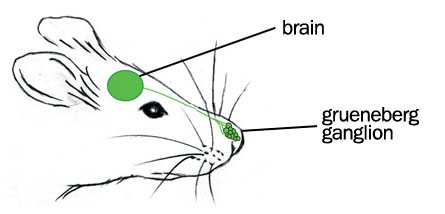 |
| FEAR-OMONE: Mice smell fear in opposite mice using a structure called the Grueneberg ganglion. The ganglion has all but 500 nerve cells that carry messages between a mouse's nose and brain. |
| Scientific discipline/AAAS |
Scientists are source to realise how mice sense reverence. According to a new subject field, the animals utilization a structure which sits inside the tip of their whiskered noses. This Grueneberg ganglion is made up of about 500 specialized cells – neurons – that carry messages betwixt the body and the brain.

Researchers disclosed this ganglion in 1973. Since then, they birth been trying to image out what it does.
"Information technology's … something the plain has been waiting for, to cognize what these cells are doing," says Minghong Ma, a neuroscientist at the University of Keystone State School of Medicine in Philadelphia, P.
Researchers already knew that this structure sends messages to the part of the mental capacity that figures out how things smell. Merely there are otherwise structures in a shiner's nose that pick up odors. So, this ganglion's true function remained a mystery.
To inquire further, researchers from Switzerland began testing the ganglion's response to a variety of odors and other things, including urine, temperature, pressure, acidity, breastmilk and message-carrying chemicals called pheromones. The ganglion unheeded everything the team threw at it. That only deepened the mystery of what the ganglion was actually doing.
Next, the scientists used extremely detailed microscopes (called negatron microscopes) to analyze the ganglion in fine detail. Based happening what they saw, the Swiss scientists began to suspect that the structure detects a certain kind of pheromone – one that mice release when they'Ra timid or in peril. These substances are called alarm pheromones.
To test their hypothesis, the researchers composed alarm chemicals from mice that had encountered a poison – carbon dioxide – and were at once dying And then, the scientists exposed animation mice to these chemical warning signals. The results were revealing.
Cells in the Grueneberg ganglions of the living mice became astir, for one thing. At the same prison term, these mice began acting awful: They ran away from a tray of water that contained alarm pheromones and froze in the corner.
The researchers conducted the same experiment with mice whose Grueneberg ganglions had been surgically abstracted. When exposed to alarm pheromones, these mice continued exploring as usual. Without the ganglion, they couldn't smell fear. Their sense of smell wasn't completely ruined, however. Tests showed that they were able to smell a out of sight Oreo cooky.
Not every experts are convinced that the Grueneberg ganglion detects alarm pheromones, or that there is regular much a thing as an horrify pheromone.
What's clear, however, is that mice do have a much more fine-tuned ability to sense chemicals in everyone's thoughts than act humans. When masses are afraid, they unremarkably hollo or wave for help. If humans were more like mice, imagine how scary it might be just to inhale the melodic phrase in an amusement park!
0 Response to "Mice sense each other's fear"
Post a Comment