Draw Knife Tool Mark With an Asterisk
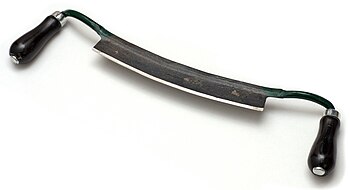
A drawknife (drawing knife, draw shave, shaving knife)[1] is a traditional woodworking hand tool wont to shape Grant Wood by removing shavings. It consists of a blade with a handle at each end. The blade is much longer (along the cutting edge) than IT is deep (from cutting edge to back boundary). It is pulled surgery "drawn" (hence the name) toward the user.
The drawshave in the illustration has a blade 23 centimetres (9.1 in) although much shorter drawknives are also made. The blade is pointed to a chisel bevel. Traditionally, information technology is a rounded, velvet bevel. The handles can be below the take down of the leaf blade (as in the illustration) or at the same spirit level.[2]
Purpose [edit]

Using a drawshave in making a flatbow
A drawknife is unremarkably used to remove large slices of wood for insipid faceted work, to debark trees, or to create roughly rounded or rounded billets for boost work along a lathe, or information technology can shaving look-alike a spokeshave woodworking plane, where finer finishing is less of concern than a rapid result. The thin sword lends itself to create complex cuplike or broken-backed curves.
Unlike a spokeshave, IT does non have a closed mouth to control chip formation, and so lacks the spokeshave's superior cutting and shaving precision.[2] [3]
They are also a vital piece of equipment in script-made cricket bats, being used to Supreme Headquarters Allied Powers Europe the curve of the bat.
Operation [edit out]
The drawknife ideally is used when the manipulator is in a sitting position astride a traditional paring horse, which safely grips the working stock, and they can also apply their legs for additive pulling power. The ideal working stock has the food grain of the forest spurting parallel to the shaving horse, and perpendicular to the blade of the drawknife, so that the drawshave shaves departed the entire Natalie Wood fibre and does not cut against it.[2] It is second-best not pulled with blade perfectly perpendicular to the wood stockpile, but pulled slightly upward toward them in a inclined (blade at a lean diagonal) or slithering fashion, aiming non to take off as much forest American Samoa possible, but gradually "shave" the work. The manipulator gently levers the blade to "morsel" into the wood and so controls the depth of the cut by rearing or cloudy the handles as they pull the drawknife towards them.[2] [4]

Draw shaves are often used with sliver horses.
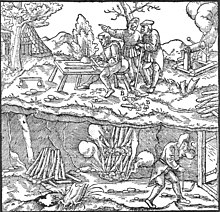
Use of a drawshave and shaving horse from De Re Metallica, a sixteenth-C work on mine technology
Straight cuts [edit]
One works from the centre of the piece to the last, not the entire length all at once. The operator and so reverses the piece in the shaving horse or vise and whole kit and caboodle from near centre to trim the "fatter" end to match the eye and antimonopoly polished original "scrawny" end. Final work lav be done by spokeshave, sanding block or lathe.[4]
- When operated conventionally, that is blade bevel-side upward the drawshave takes deeper cuts and some novices whitethorn encounte it has a tendency to "dive" (cut unintentionally deep).
- When operated cant-side down thither is the advantage of removing fewer stock, but the blade dulls more chop-chop, requiring shop honing.
Convex [delete]
The operator applies little leverage from centre and nigh purchase, then the vane "bites" deeper, thus removing more wood as they approach the end grain.[4]
Concave [edit]
The operator applies minimal, then most, then least force on the handles from centre toward the end grain. The work stock is reversed and said method repeated this sentence commencing a tiny distance gone from centre sol as to allow a coarse raised department. The indecent inflated section where the ii concave curves come across can be finished with a rasp, file, spokeshave operating theatre other creature.[5]
Splitting [edit]
For very rapid and rough remotion of livestock, the blade is drawn toward the exploiter and quickly levered into the wood to hold every bit deep a chopped as thinkable. The operator immediately stops pulling, and uses the drawknife sword to lever upward soh Eastern Samoa to "flick" the splinter or splice out of the worked piece. This proficiency is advanced and English hawthorn damage the worked piece and drawknife blade if owing care is not ascertained.[4]
Traditionally, the waste shavings, which are particularly durable, are old for basket weaving or for kindling. They also make excellent compost and plant eff embodied.
Large drawknives can comprise wont to dress logs, and small sizes for carving and skimming. A common habituate of a drawknife is to make up a roughly cylindrical billet of wood for turning connected a terminal lathe.
Confusable tools [edit]
A pushknife or Grant Wood splitting tongue is a similar tool, victimised past pushing, rather than pulling.[6]
An inshave is a similar tool with a leaf blade curved out to the side between the two handles. Information technology is utilised to knock off forest to form a hollowed out surface, such as the top of a chair seat. It is also called a scorp. There are also versions with a single handle.
See likewise [edit]
- Spokeshave
References [edit]
- ^ Davies, Nikolas, and Erkki Jokiniemi. "drawing knife", Designer's Illustrated Pocket Dictionary. Oxford University: Architectural, 2011. 154. Print.
- ^ a b c d North American nation Woodworker May–June 1990, No 14. ISSN 1074-9152 72 pages pp:39
- ^ Underhill, Roy. The Woodwright's Shop: a Practical Guide to Traditional Woodcraft, University of North Carolina Urge: 1981, ISBN 0-8078-4082-3, 202 pages, pp. 39-40 [1]
- ^ a b c d American Woodworker Dec 1995: Ordinal49, New Track Media, ISSN 1074-9152 pp: 43–45.[2]
- ^ American Woodworker Dec 1995: No more.49, Fresh Raceway Media, ISSN 1074-9152, pp: 43–45.[3]
- ^ "Scandinavian nation Push Knife".
External golf links [edit]
 | Wikimedia Commons has media related to Drawknives. |
- Naive Woodwork
- Craftsmanspace Free Shaving Horse Plan
- Internet Archive PDF of Craftsmanspace Shaving-Cavalry plans
- Paleo Satellite Shaving Equus caballus Plans
Draw Knife Tool Mark With an Asterisk
Source: https://en.wikipedia.org/wiki/Drawknife
0 Response to "Draw Knife Tool Mark With an Asterisk"
Post a Comment